> For the complete documentation index, see [llms.txt](https://docs.yaycommerce.com/yaymail/llms.txt). Markdown versions of documentation pages are available by appending `.md` to page URLs; this page is available as [Markdown](https://docs.yaycommerce.com/yaymail/how-it-works/email-templates.md).
# Email Templates
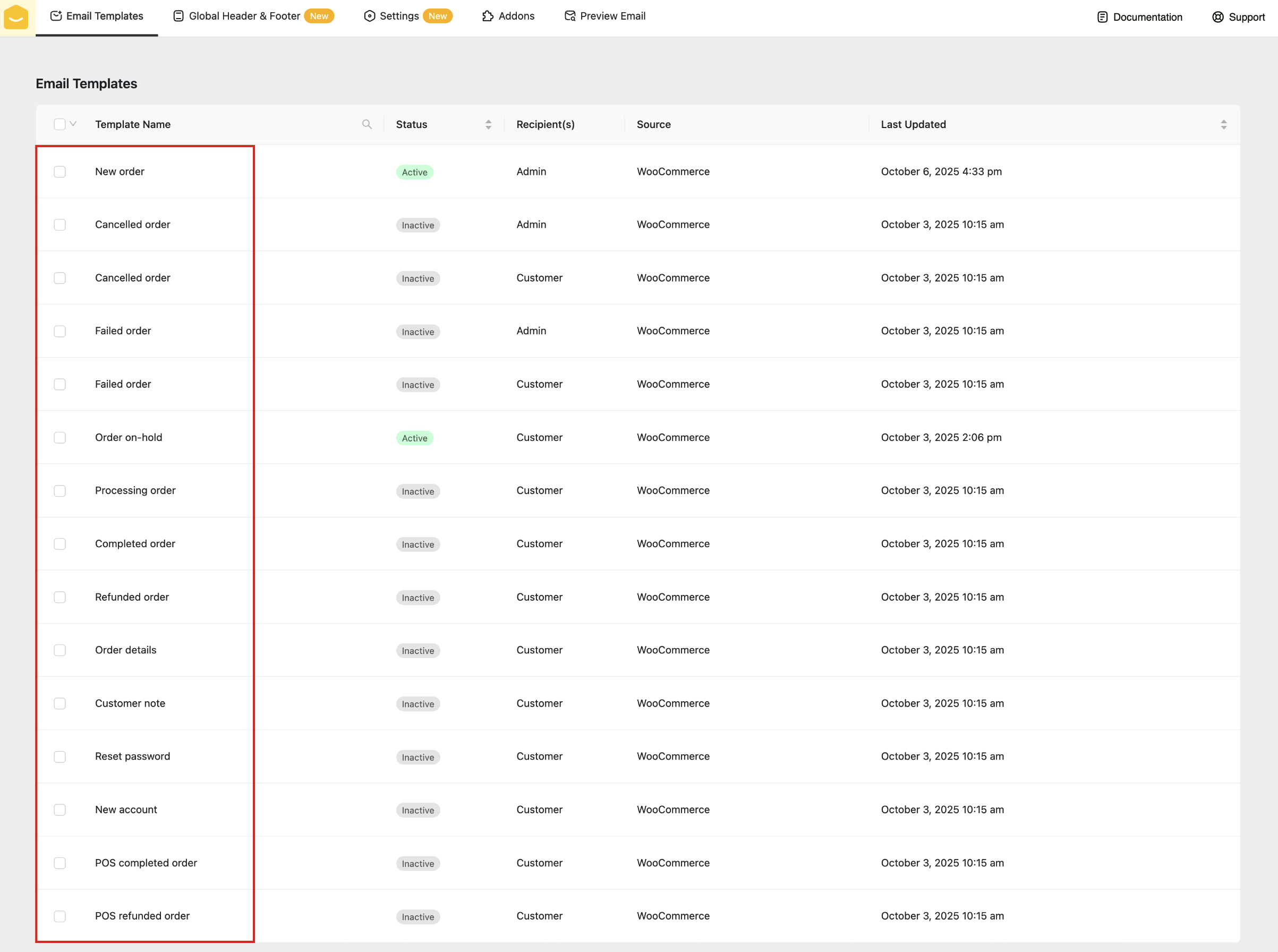
The **Email Templates** tab displays a complete list of all email templates available on your site, including default WooCommerce templates and those added by third-party plugins.
By default, you can customize 15 WooCommerce email templates. They are called:
* **New order** (Notifies the admin that a new order has been placed)
* **Cancelled order (Admin)** (Notifies the admin when an order is cancelled)
* **Cancelled order (Customer)** (Send to the customer when their order is cancelled)
* **Failed order (Admin)** (Notifies the admin when an order fails)
* **Failed order** **(Customer)** (Sent to the customer when their order fails)
* **Order on-hold** (Sent to the customer when the order status is changed to "On-Hold")
* **Processing order** (Sent to the customer when the order status is changed to "Processing")
* **Completed** **order** (Sent to the customer when the order status is changed to "Completed")
* **Refunded order** (Sent to the customer when an order is refunded)
* **Customer invoice / Order details** (Sent to the customer with order information and payment links)
* **Customer note** (Sent to the customer when the admin adds a note to the order)
* **Reset password** (Sent to the customer when they request a new password)
* **New account** (Sent to the customer when they create a new account)
* **POS completed order** (Sent to the customer when they have successful in-store transactions that were created via your Point of Sale system)
* **POS refunded order** (Sent to the customer when they refund via POS system, not from the online shop)
For each template, you can view the following details:
* **Status** – Indicates whether the template is currently active or inactive.
* **Recipient(s)** – Shows who will receive the email (e.g., Admin or Customer).
* **Source** – Identifies the plugin that generated the template (e.g., WooCommerce).
* **Last Updated** – Displays the most recent date and time the template was modified.
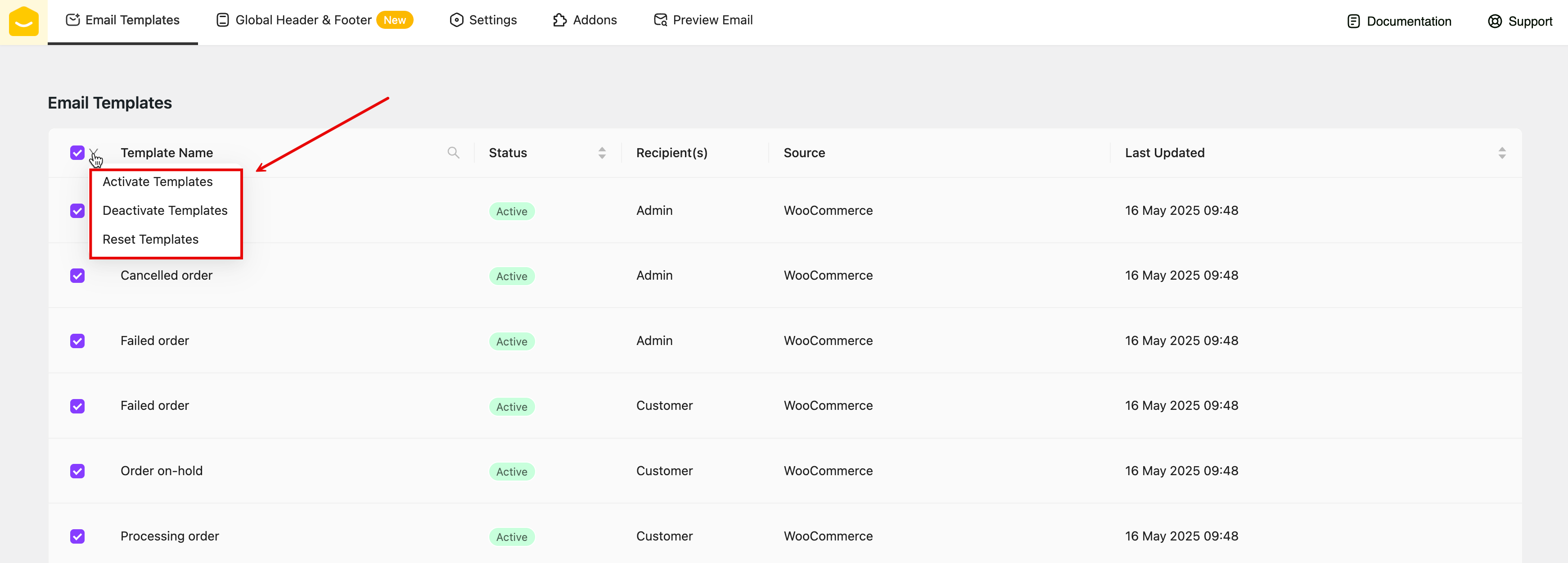
From this screen, you can also perform **bulk actions** to manage your templates more efficiently. These include: **Activate Templates/Deactivate Templates/Reset Templates to Default.** To perform a bulk action, simply select the templates using the checkboxes and choose your desired action from the toolbar.
**Note:**
* If your site has other emails which are not the above 15 emails, please check our [**YayMail addons here**](https://docs.yaycommerce.com/yaymail/compare-yaymail-free-and-pro#yaymail-premium-addons).
* You must select Email type as HTML in the settings of each email in order for YayMail to work.